
Interview with Brian Bergstrom

Brian Bergstrom is an English-language translator of Japanese literature, including Erika Kobayashi’s novel Trinity Trinity Trinity, Fumio Yamamoto’s short story collection The Dilemmas of Working Women, and Kōtarō Isaka’s quirky thriller Hotel Lucky 7. In the below interview, Bergstrom answers my questions on the relationship between translation, liminality, and fiction.
What do you think is the relationship between translation and liminality?
I’ve never quite thought of it in these terms, but there’s a way in which translation is by nature liminal–an antechamber between an original and the reader that the work must pass through. I don’t think liminality is the same as marginality, though—liminal spaces are essential, and so is translation. But there is a secondhand-ness to the experience of translation that might resonate with the liminal—the way the translator is hearing music from an adjacent room that they then try to recreate in all its fullness where they are. The position of the translator is one in which you inhabit slippage as a place in its own right.

What does liminality mean to you? Are there any novels/songs/films/etc. that you think capture a sense of liminality?
The liminal is hard to define, but in terms of media, I think of movies like Koreeda’s Distance, which use a deliberately indirect sense of place to talk about something that always lies somewhere beyond direct representation. I also think Summer Vacation 1999 by Kaneko Shūsuke thematizes the liminality of its story through the liminality of its setting (an empty boarding school during the summer) and of its other aesthetic choices, including its omnipresent but never explicitly acknowledged cross-gender casting.
I love reading fiction in translation (especially Japanese fiction), as it allows me to detach from the place I am physically in and go somewhere else. However, I’ve always struggled learning other languages, so I’m aware there are some aspects of the original texts that I am missing. Do you think that it is necessary for someone to read fiction in its original language to properly understand it?
Not to be frustratingly elliptical, but it depends on the nature of understanding you’re after. There are always things about an original that necessarily cannot make it into a translation – linguistic aspects, specific metaphors or jokes or references. A good translation conveys the feeling and import of the original, in my estimation, and to do so, sometimes analogues are used instead of direct transmission of each word/phrase/idiom. Which means that if your interpretive lens is linguistic (for example, deconstructive), there will be things that only the original can help you with, and you also run the risk of overreading choices that are the translator’s, not the author’s. But I also think that translated texts offer so much of an original that they can be analysed in most other ways (historical, narratological, feminist/queer theory-engaged, postcolonial, Marxist, etc.) perfectly well. I think dwelling on what’s “missing” in a translation is counter-productive, and provides cover for underreading what’s actually there in a translation, which is quite a lot (and sometimes translation provides clarity or insight into an original, so the effect can be additive at the level of comprehension; translation is a form of close reading after all, as well as analysis).
You recently translated The Dilemmas of Working Women, a collection of stories by Fumio Yamamoto. I heard that HarperCollins initially wanted to use a Miwa Yanagi1 photograph for its cover. This would have been an interesting choice. Yamamoto’s stories are based in reality, while Yanagi’s photography creates a surreal world of its own. Still, they fit together well, since Yanagi creates that surreal world out of Japanese women’s everyday experiences. What are your own thoughts on Yamamoto, Yanagi, and their relationship to liminality?
That’s a funny story, in that it was actually me who suggested Yanagi Miwa’s photography for the cover (HarperVia asked if I had any ideas). The designer really responded to her early Elevator Girls pieces and even designed a few cover choices using them (see this post by the designer:
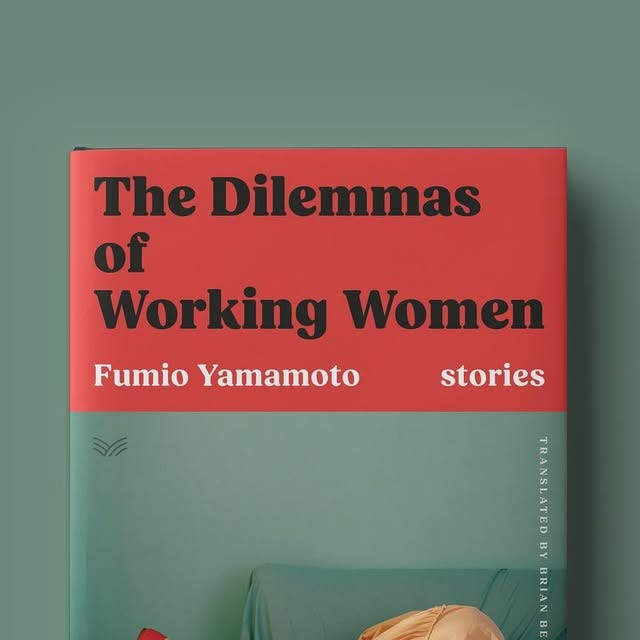
We had to move away from Yanagi’s work because the parent company (HarperCollins) demanded model releases for the women in the images, which, due to how long ago she took the photos, Yanagi couldn’t provide. So in the end, they went with the image by the other photographer, though I think it was a great choice—and one obviously influenced by the work with Yanagi’s photos. And so the “surreal” aspect of Yanagi definitely informed the way the book was presented to the North American market—and I think that while it’s true that Yamamoto is (at least in this book) working within realism, Yanagi’s interventions access the psychology beneath that everydayness, the pervasive feeling of constriction and awkwardness Yamamoto’s characters feel as they interact with both their intimate circles and with society at large. The Elevator Girls series really accesses this as well, the girls both beautiful and trapped, on display yet anonymous, and so on. So I think there’s a real resonance there.
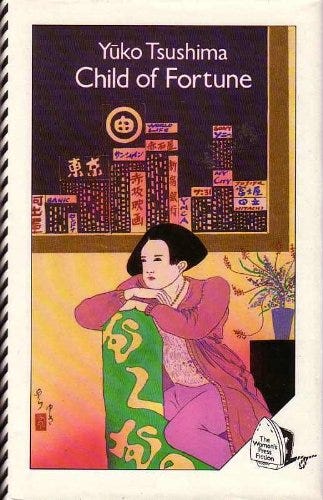
The Dilemmas of Working Women reminds me a lot of Yuko Tsushima’s novels and Yamada Murasaki’s comics. Would they have been an influence on her?
I have only read a small amount of Yamamoto’s interviews talking about her own work, so I can’t say for sure, but I have not run across any mention of either. But it’s extremely likely that she was familiar with both as she wrote; Yamada especially seems very close to her sensibility, and she has mentioned that she was an avid reader of manga as she began her literary career.

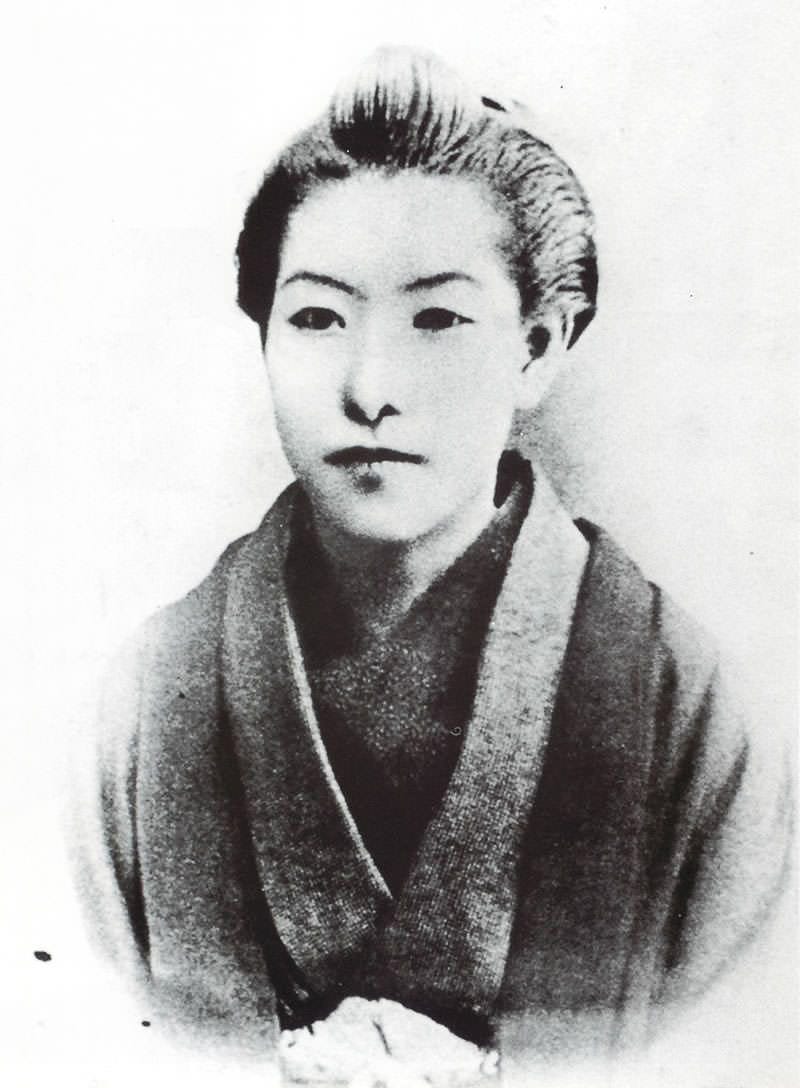
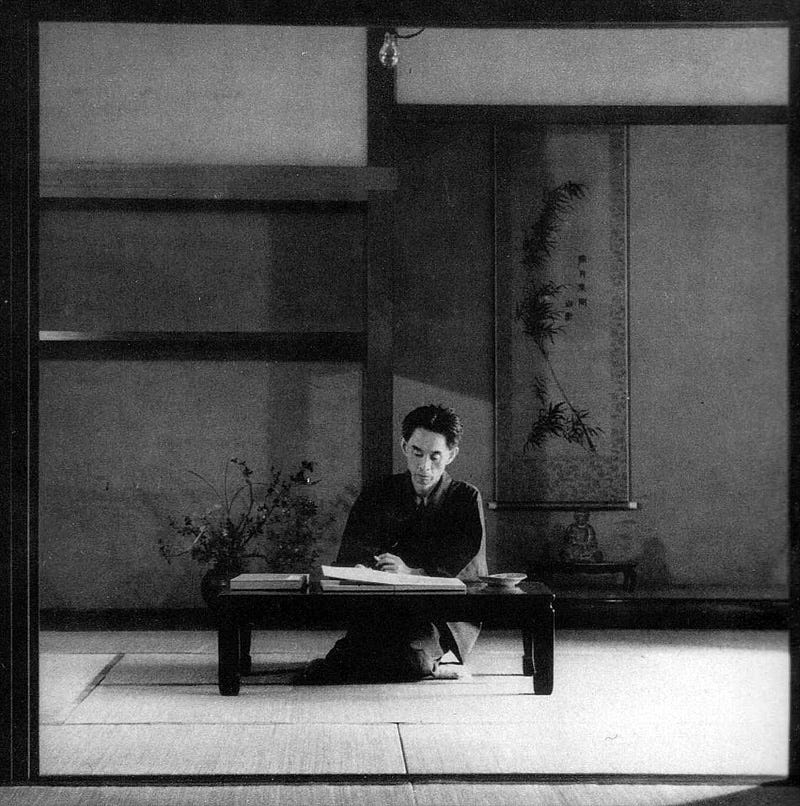
Contemporary Japanese fiction in English often has this very immediate, clear style, with vivid imagery. It is sparse, but in a different way from older Japanese literature, such as Yasunari Kawabata or Higuchi Ichiyō. It also often captures the quiet strangeness of everyday urban life. I think this works well to create a liminal atmosphere.
Style in Japanese literature is something that is very hard to talk about directly, especially over time, as the discussion can get very complicated. Suffice to say that someone like Higuchi Ichiyō was self-consciously mimicking premodern forms of prose in her work (specifically Saikaku2), which were going through a bit of a revival at that time; this anachronism in her work feeds into her themes, which are frequently about vestiges of older forms of Japanese everyday life that persist in the context of the newly modern city. So the style is self-consciously allusive, prolix, even florid. Kawabata, on the other hand, came out of “high” modernism and experimental writing in the 20s and 30s; his later style (starting with Snow Country) pares that style down to what he saw as its essence; to me, this is less about Japanese-ness (though he himself sometimes spoke of it that way) than about trajectories of modernism; think of Joyce’s style and its relation to Pound or Eliot (and of course, there is an influence of Japanese poetry and prose on those figures as well!). So Kawabata’s spareness can be conveyed quite well in English translation despite its supposed foreignness—it’s really no great accident.
The kind of modernism I’m talking about is influential on the styles of later Japanese writers, as well as on the form of English that translators like me use; the pared-down, “clean” sentence is an ideal in both, at least in most realist or “pure literature” works. I think the missing link here in this particular story might be Murakami Haruki, though, who brings this (in his case, explicitly American-influenced) style into contact with magical realism, etc. I think the almost anti-lyrical style of Murakami and the more poetic, yet still pared-down, style of Kawabata are very different overall, but they combine to create two models of prose that are quite dominant in both Japanese mainstream literature and the English used to translate it.
But this is not the whole story at all – there are many writers who move in other directions in terms of style; Mishima, for example, is much more prone to luxuriously rich prose; Tsushima Yūko’s later work (for example, the recently translated Wildcat Dome3) also moves away from the “clean, clear” style and toward a more imagistic, free-associative and even surreal form of prose. Hoshino Tomoyuki’s writing is also prone to complex, image-studded sentences, as his influences include Latin American writing and writing by less-translated Japanese writers like Nakagami Kenji. Yamamoto’s style is more mainstream than that, but one thing I wanted to preserve in my translation is her conversational tone—her narrators are a bit chatty, and we’re allowed to be quite close to their thoughts as they come, in a way that allows for more everyday texture on the surface than some other popular translated writers.
In Erika Kobayashi’s Trinity Trinity Trinity, the mother character accesses an anonymous dating site using a handheld device in a public toilet. My research is on liminality in both urban and digital contexts, and here we see both come together. Neither the dating site or the public toilet is perfectly safe or private, but they do allow for some privacy and anonymity. In some ways, this scene from the novel reminds me of the kind of nocturnal meetings in public parks described by Yukio Mishima, updated for the internet age. What are your thoughts on this moment from the novel?
I think this is a great reading of those scenes from TTT—the sense of danger and exposure coexisting with the sense of privacy and comforting (or thrilling) secrecy is definitely part of the story here; this is especially resonant with the later shocking revelation that the anonymity of the dating site led to her inadvertently sexting with her own (queer, possibly trans) daughter (misrecognition enabling recognition). The internet in general plays an interesting role throughout the novel, enabling connections and alternative modes of being to come into contact even as it also exposes those very things to danger; think of the grandmother’s lacemaking blog, or the site of the artist Re:, or the images from Fukushima characters watch on their computers. But the evocation of the bathroom in conjunction with the dating site also brings up something that I think may be related to liminality—abjection. How do they inform each other, in your view? The abject is a sliding between objecthood and subjecthood, a reminder of everything that must be thrust aside to be a functional social being, psychoanalytically speaking; a liminal space plays a similar role in relation to privacy and publicity, I’d say—troubling the distinctions between identity and anonymity, exposure and hiddenness, and so on. And it might be here that the liminality of a space like a public toilet where you experience bodily abjection interfaces with alternative forms of sociality, either via digital interfaces like the phone or in person, as in queer cruising.
Trinity Trinity Trinity has a unique atmosphere. Sometimes it feels ephemeral, and other times more grounded. I’m looking forward to reading more of her work.
I hope you have also checked out the collection Sunrise, as it contains novellas and short stories that I think you’d find similarly interesting, including a novella called “Shedding” that I think you’d find useful in approaching liminality as a literary theme.
What influence do you think architecture and the design of buildings has on Japanese fiction? What influence do you think the internet has on Japanese fiction?
I think that architecture of everyday spaces affects the texture of everyday lives, so it necessarily affects literature. The architecture of a traditional house, with the open veranda running down one side and the tatami rooms inside, create environments for scenes that would be hard to stage in a more Western-style house (think of the scene near the end of the last story in Dilemmas, or the mother’s house in “Here, Which is Nowhere”* in that same collection); the danchi-style apartment building is also pretty determinative of the experience of everyday life, as well as the prevalence of large-scale multi-use buildings like the one where the protagonist of the Dilemmas story “Naked” lives (and think about the contrast between that apartment and the one where Little Ken lives, which is rundown but more “traditional” and open to the outside world, and located in a part of the city that has more green spaces than downtown Shinjuku.).
In terms of the internet, I think it has affected Japanese literature in exactly the way it has affected literature everywhere – like all forms/forums for sociality, it’s both a vehicle for alienation and communion, information-sharing and misinformation-sharing.
Have you read translator Polly Barton’s non-fiction book Fifty Sounds?
I have read that book, I think very highly of it and of Polly in general!
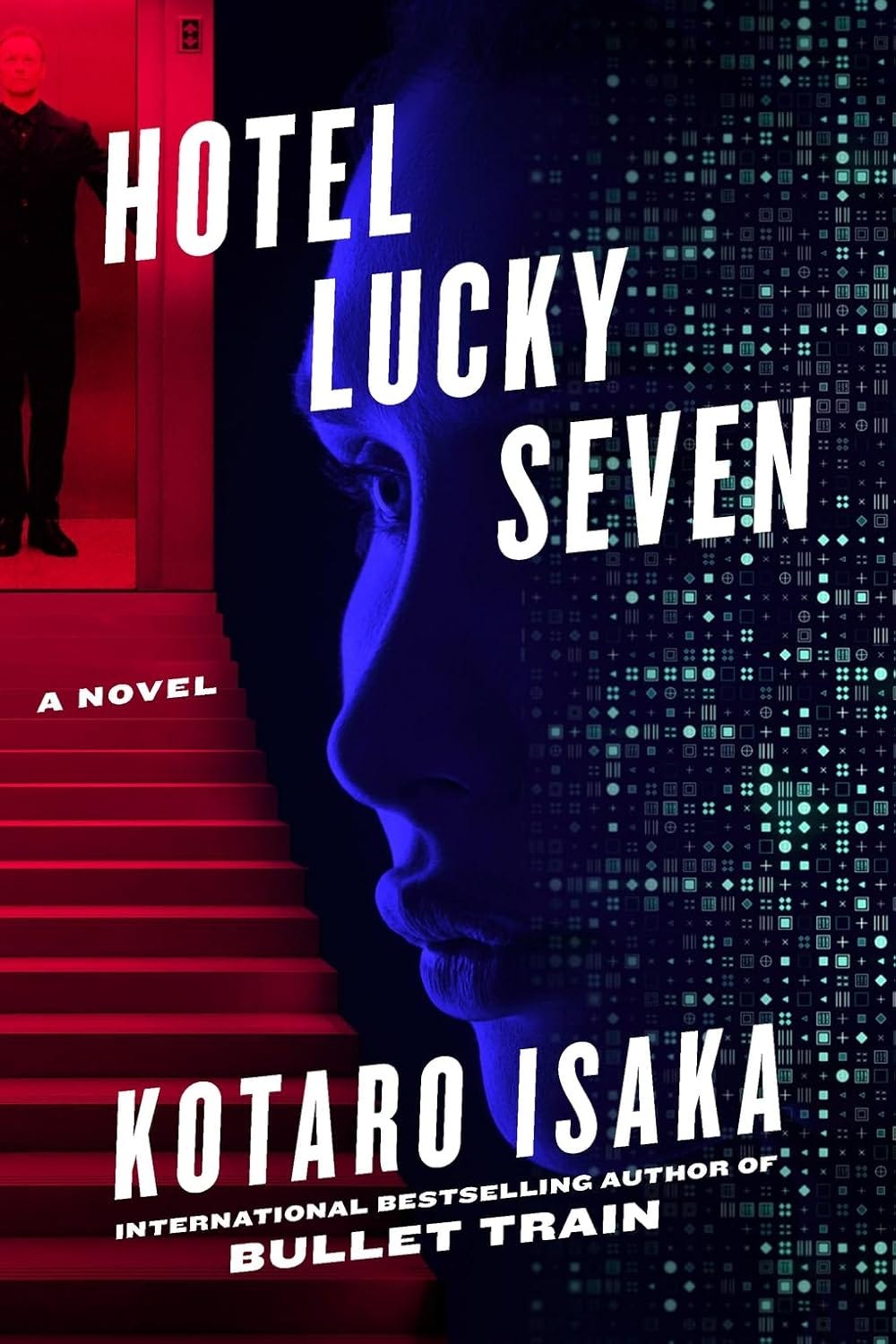
I think it’s interesting that Kōtarō Isaka’s Hotel Lucky Seven opens in a hotel. Thrillers and mystery novels often make use of in-between places in interesting ways. I also love that the first two characters the reader encounters are named Blanket and Pillow.
This book is a sequel to Bullet Train, and it struck me (and I confirmed this when I met him recently) that he thought of using a hotel because in many ways, it’s like a train tipped on its end; the horizontal movement through a corridor between compartments/rooms becomes a vertical one using elevators and stairwells. I also think his shadow-world of assassins finds its natural home in these liminal non-spaces like the train and hotel; the joke in both novels is that the assassin keeps wanting to leave these non-spaces and keeps getting pulled back in. Isn’t that like being a killer-for-hire in general: you inhabit a shadowy, hidden world that exists in the overlooked spaces within everyday life, and you end up unable to really leave that hidden world even though the “real” world is right there all around you. I love Blanket and Pillow as well, it’s his only female pair and it’s interesting that part of their effectiveness is that they blend in as maids/cleaning ladies, which makes them able to go places essentially undetected, just as their femininity allows them to be productively underestimated by their targets.
Thank you so much to Brian Bergstrom for taking the time to answer my questions! His insights will be very useful in my own PhD research. I encourage everyone reading this to check out his work.
If you enjoyed this post and would like to read more like it, please consider sending me a tip on Ko-Fi.
Check out my previous post on Miwa Yanagi’s Elevator Girls series.
Ihara Saikaku, whose work includes The Life of an Amorous Woman, trans. Ivan Morris. Maybe I’ll review his fiction sometime soon.
I was surprised by Wildcat Dome; it’s good, but very different from Tsushima’s other translated works.